Pirate Flags & the Jolly Roger
History, Skull and Crossbones & the Symbols of the Golden Age
Most pirates wanted to avoid bloody close-contact fighting when possible, so the pirate flag was among the most effective weapons in the entire Golden Age of Piracy arsenal. A well-chosen flag, hoisted at the right moment, could break a crew's will to resist from half a mile away — no cannon required. The Jolly Roger and its many variants were instruments of psychological warfare as much as they were symbols of identity. Read on to discover the history of the Jolly Roger, the meaning of the skull and crossbones, the stories behind the colors, and the personal flags of the most famous pirate captains.
In this article: Jolly Roger origins / famous captains’ flags / other pirate flags / flag colors / flag symbols
The Origin of the Jolly Roger Pirate Flag
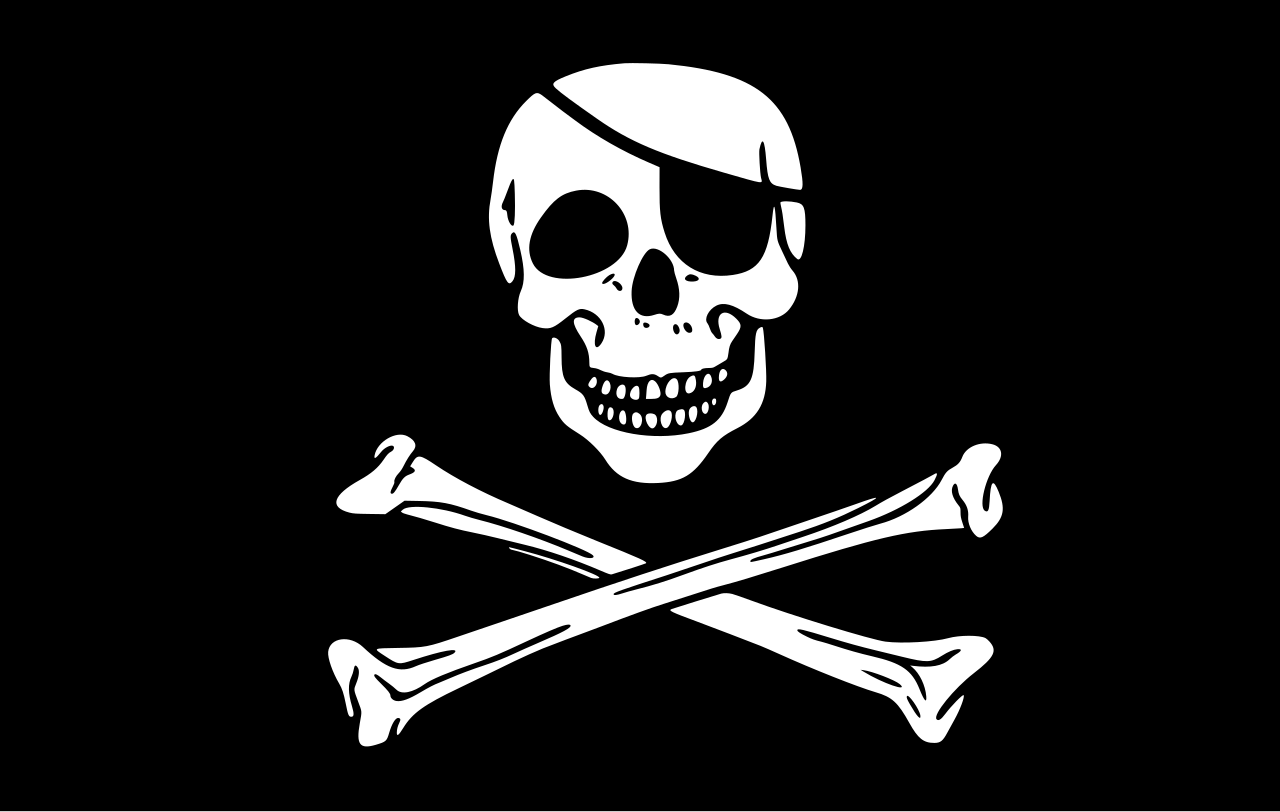
The name itself is a puzzle. Some say the Jolly Roger derived from Jolie Rouge — the “pretty red” flag flown by early pirates to announce that no quarter would be given. Others point to “Old Roger,” a slang term of the era for the devil himself. A third possibility is that “jolly roger” was simply period English for a cheerful, carefree vagabond — an ironic name that stuck. What is certain is that by the early eighteenth century the term had come to describe all the varied black flags of the Golden Age, regardless of their design.
The name appears in written records for the first time in Captain Charles Johnson’s A General History of the Pyrates, published in 1724. Johnson names two captains who specifically called their flag the Jolly Roger: Bartholomew Roberts in June 1721 and Francis Spriggs in December 1723. Notably, neither of their flags bore the classic skull and crossbones — which tells us that “Jolly Roger” was already a generic name for black pirate flags, not a description of any one design.
Emmanuel Wynne is generally credited with flying the first documented Jolly Roger around 1700: a skull and crossbones on a black field with an hourglass below it — that last detail a pointed reminder that the time to surrender was running out. The skull-and-crossbones design spread rapidly through the pirate world in the decade that followed. What is striking in hindsight is just how brief its reign was: the Jolly Roger in its most familiar form was in active use for only about twenty years, from roughly 1716 to 1726, at the very peak of the Golden Age. In that narrow window it became one of the most recognizable symbols in history.
The Origin of the Skull and Crossbones
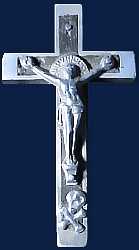
Public domain.
The skull and crossbones symbol so central to pirate flag history may have been inspired by tombstone carvings, but another possible origin is the crucifix. In the 17th century, crucifixes almost always depicted a skull and crossed bones beneath the cross — symbols of the death that Christ was said to have conquered. These also referred to Golgotha, the hill of the crucifixion, whose name in Greek means “the skull.”
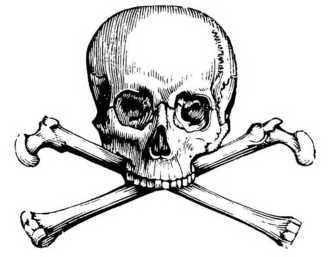
symbol of piracy. Public domain
This religious imagery fell out of favor in the 1800s as the pirate association became overwhelmingly dominant. There is also a more prosaic documented source: the ship’s log. Captains of the era marked a skull next to a crew member’s name when that sailor died during a voyage. Pirates knew the logbooks of the ships they captured intimately — it is entirely plausible that the practice migrated from the page to the flag. Popular culture and Hollywood have since layered so much mythology over the symbol that recovering the full historical truth is nearly impossible. What remains clear is that by 1700, the skull and crossbones carried an unmistakable message, one that required no translation in any language spoken on the Atlantic.
The Personal Flags of Famous Pirate Captains
One of the less appreciated facts about the Jolly Roger is that it was not a uniform. Each captain who chose to fly one designed something personal — and for the few whose flags are historically documented, those designs were known and feared by sailors across the Atlantic. If you saw a particular flag, you knew exactly who was coming. Here are the flags of some of the most notorious captains of the Golden Age — with a word on which are genuine history and which are legend.
⚓ A Historian's Note on Pirate Flags
Most pirate flags you'll find online — including those attributed to Calico Jack, Stede Bonnet, and Edward Low — are modern inventions, many traceable to a 1959 German book. No contemporary source confirms what flags these pirates actually flew. We present the traditional designs here because they've become part of pirate lore, but we'll tell you which are historically documented and which are legend. Bartholomew Roberts is a rare exception: his flags are among the few with genuine historical evidence behind them.
Blackbeard — Edward Teach
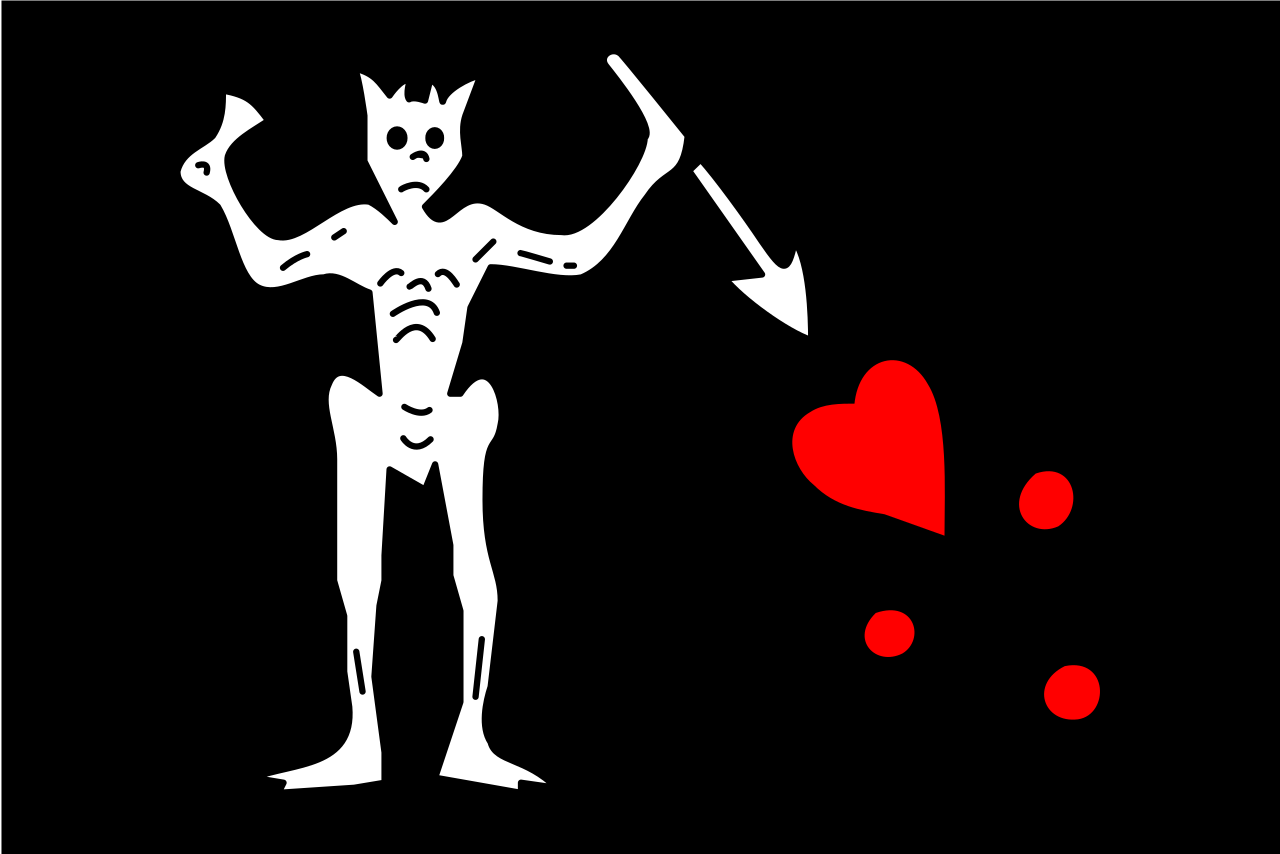
— its exact historical origins are uncertain."
Blackbeard’s flag brought together nearly every element of Jolly Roger symbolism at once: a horned skeleton holding an hourglass in one hand and a spear in the other, the spear aimed at a heart letting out three drops of blood. It was the most elaborate and deliberate pirate flag of the Golden Age — a design calculated, like everything about Blackbeard, for maximum psychological effect. The horns placed death itself in the role of a devil. The hourglass warned that time was up. The bleeding heart promised that resistance would be personal and painful. When this flag appeared on the horizon, most captains had already made their decision before the ships were within cannon range.
Blackbeard later noted in his journal that a crew member had suggested adding a flintlock pistol, a bottle of rum, and a small yet fashionable tricorn hat to the skeleton’s other hand — but that he felt this risked making the whole thing look cluttered, and a cluttered flag sends a cluttered message.
Bartholomew Roberts — Black Bart
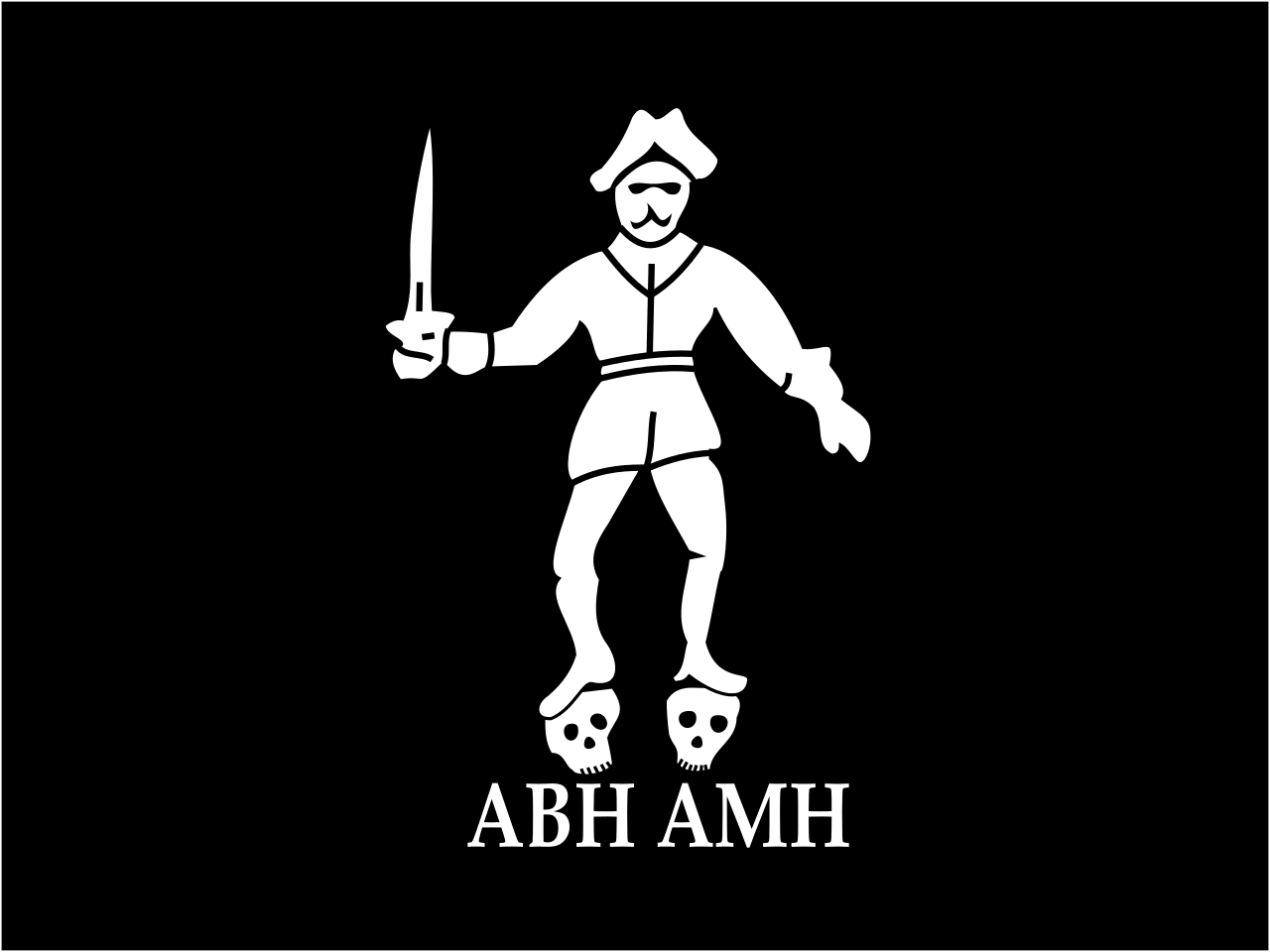
ABH & AMH: "A Barbadian's Head" and
"A Martiniquian's Head." One of the few
historically documented pirate flags. Public domain.
The most successful pirate of the Golden Age flew not one but several flags, each tailored to send a specific message. One showed Roberts himself standing astride two skulls labeled ABH and AMH — “A Barbadian’s Head” and “A Martiniquan’s Head” — a direct declaration of his contempt for the governors of those islands who had made the suppression of piracy their business. Another depicted Roberts sharing a toast with a skeleton, which, when you consider the alternatives being offered on other flags, was arguably the friendliest pirate flag in the Atlantic. He also flew a black flag bearing a death’s head with a cutlass, and a fourth showing a skeleton with an hourglass. Roberts understood that flags were communications, not decorations, and he chose them accordingly.
Calico Jack — John Rackham
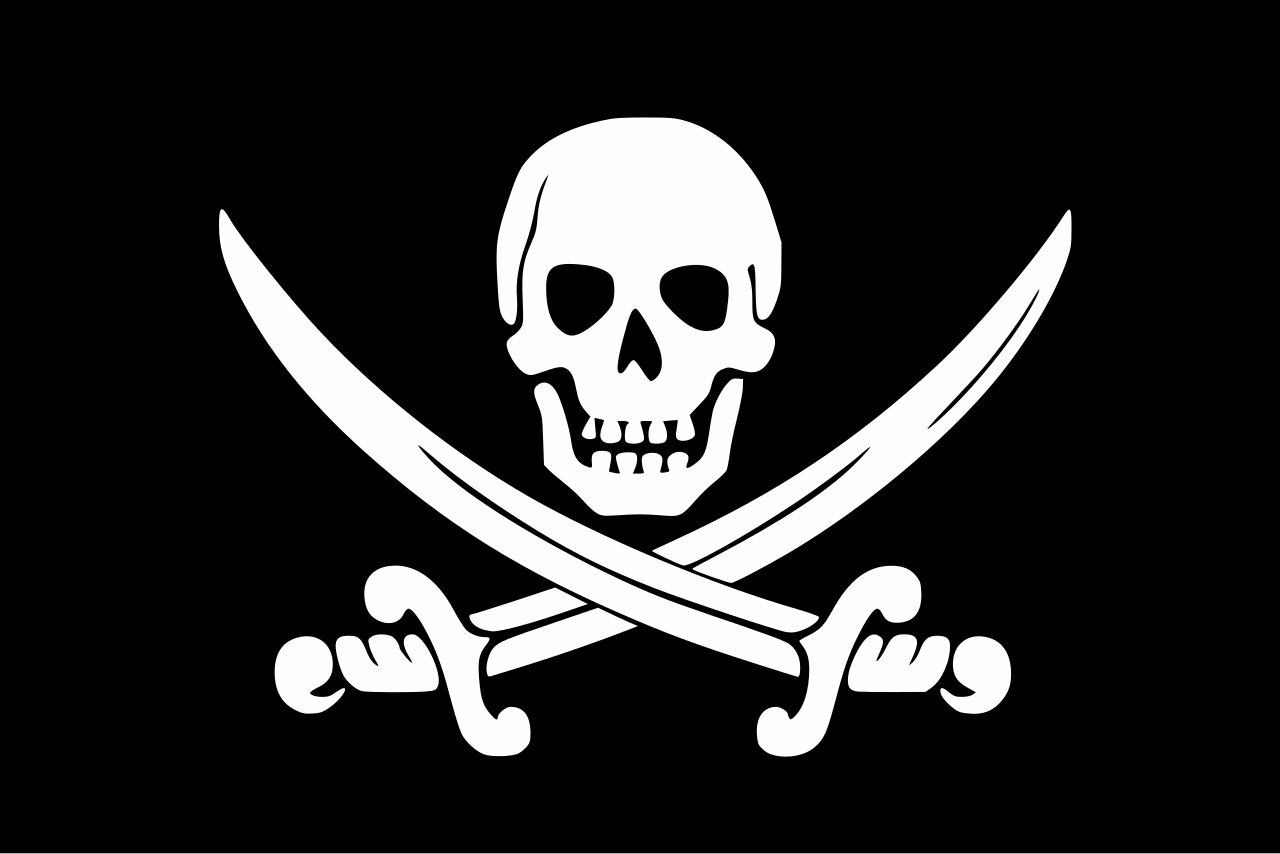
skull above crossed swords. A widely recognized
design, though no contemporary source confirms
it was his actual flag. Public domain.
Calico Jack Rackham flew one of the more distinctive flags of the era: a skull above two crossed cutlasses, replacing the traditional crossed bones with the tools of the trade. The design was simple, direct, and immediately identifiable. Rackham’s flag is remembered in part because his crew included two of the most remarkable figures in piracy — Anne Bonny and Mary Read — and because the flag flying above their sloop was, by all accounts, the most threatening thing about them when the authorities finally caught up.
Stede Bonnet — The Gentleman Pirate
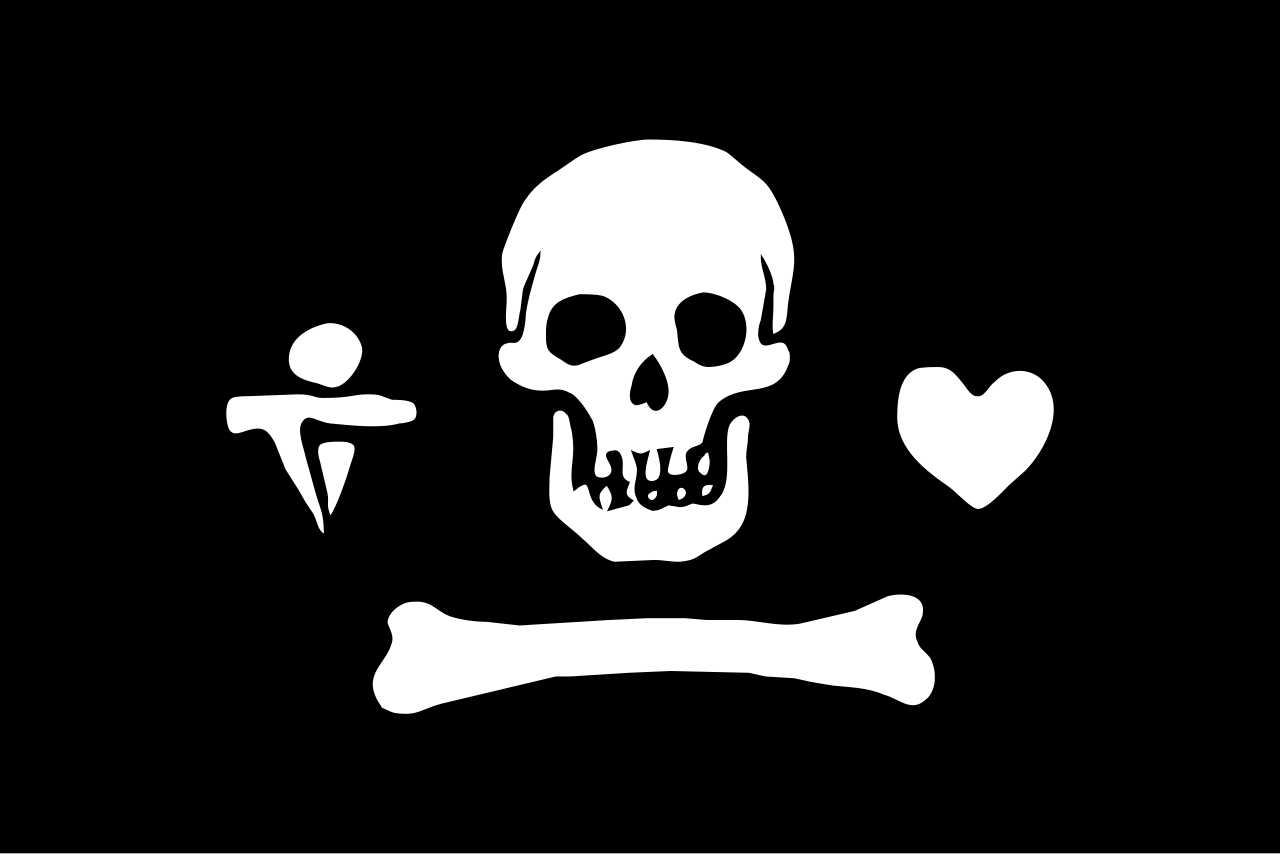
the "Gentleman Pirate" — skull, heart, dagger and bone.
A recognized design, though no contemporary source
confirms it was his actual flag. Public domain.
Stede Bonnet, a Barbadian plantation owner who abandoned a life of comfort for an inexplicable career in piracy, flew a flag that matched his somewhat confused approach to the profession. His Jolly Roger featured a skull above a horizontal bone, with a heart on one side, a dagger on the other, and a single bone beneath — an eclectic combination that managed to include most of the standard symbols without committing fully to any particular message. It is the flag of a man who had read about piracy more than he had practiced it, which was, in fairness, an accurate description of Bonnet at the time he designed it.
Edward Low
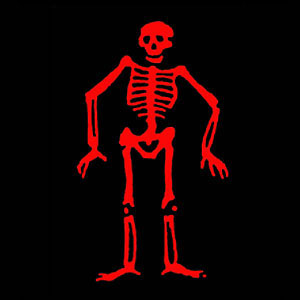
a red skeleton on a black field.
No contemporary source confirms it was
his actual flag. Public domain.
Edward Low was by reputation the most brutal pirate of his era, and his flag reflected the fact without subtlety: a red skeleton on a black field. No hourglass. No heart. No invitation to negotiate. Low’s victims frequently reported that no quarter was offered regardless of whether they resisted, which made his flag, if anything, an understatement. He is one of the few Golden Age pirates whose flag color — red on black, rather than white on black — reinforced the no-quarter message before anyone had even seen what was drawn on it.
Other Types of Pirate Flags
National Flags and False Flag Tactics
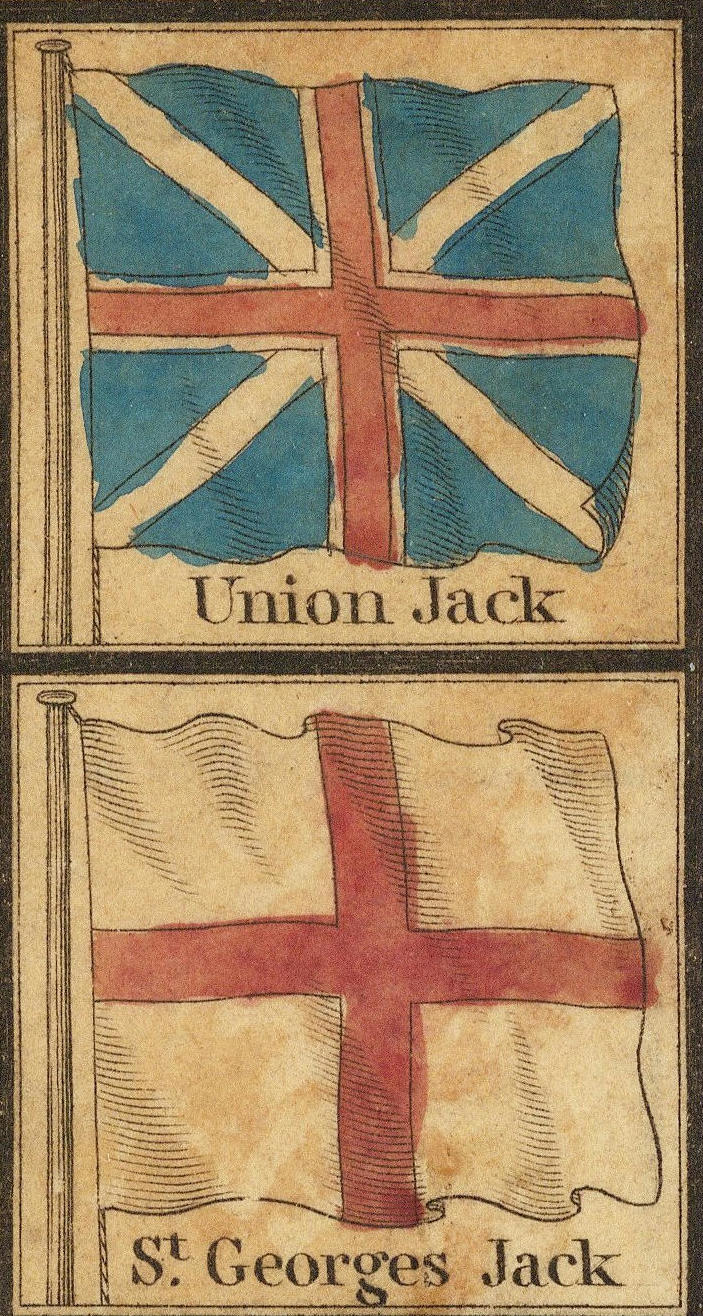
Public domain.
Since medieval times, ships at sea flew their national flag as a form of identification. Some pirates flew no personal Jolly Roger at all, sailing instead under their homeland’s colors — as Caribbean buccaneers were commonly known to do. When a captain held a letter of marque or privateering commission, the commissioning nation’s flag was not optional: it was a legal requirement, the document that separated a privateer from a common pirate in the eyes of international law.
A common ruse de guerre — a strategy of war — was to fly the same national flag as the intended target, allowing a pirate vessel to approach under the guise of a friendly ship. Once within effective range, the national flag came down and the Jolly Roger went up, giving the target crew a final, brief opportunity to assess their options. The tactic worked because ships at sea had no other means of identifying an approaching vessel at distance. A flag was the internet of its day: the only communication channel available, and therefore the one most worth manipulating.
Pirate Flag Colors and Their Meanings
Solid-colored pirate flags predate the skull-and-crossbones era of the Jolly Roger by generations. Each pirate flag color carried a specific, widely understood meaning — a shared vocabulary of threat that required no literacy to decode.
Black
The original color of pirate flags. A solid black flag raised as a pirate vessel closed the distance meant one thing: surrender now, and your lives will likely be spared. Black was a warning and an offer simultaneously — the language of a profession that preferred cargo to combat.
White
Counterintuitively, a white flag in the pirate context was not a signal of surrender from the pirates — it was a demand for surrender from the prey. The message was simple: you must give up. The white flag was the calm before the black one, a last reasonable request before more colorful options were considered.
Red
The most feared color on the water. The red flag — the original Jolie Rouge — declared no quarter: no mercy would be given regardless of what the target did. Surrender would not save you. Resistance would not hurt you any more than surrender would. It was a flag that, in theory, gave the pirates an advantage by inducing panic and paralysis. In practice it occasionally backfired spectacularly: sailors who knew they were dead regardless of their actions had every incentive to fight as hard as they could, and a desperate crew fighting for their lives is considerably more dangerous than a crew that still has something to lose.
Pirate Flag Symbols: Skull, Crossbones, and More
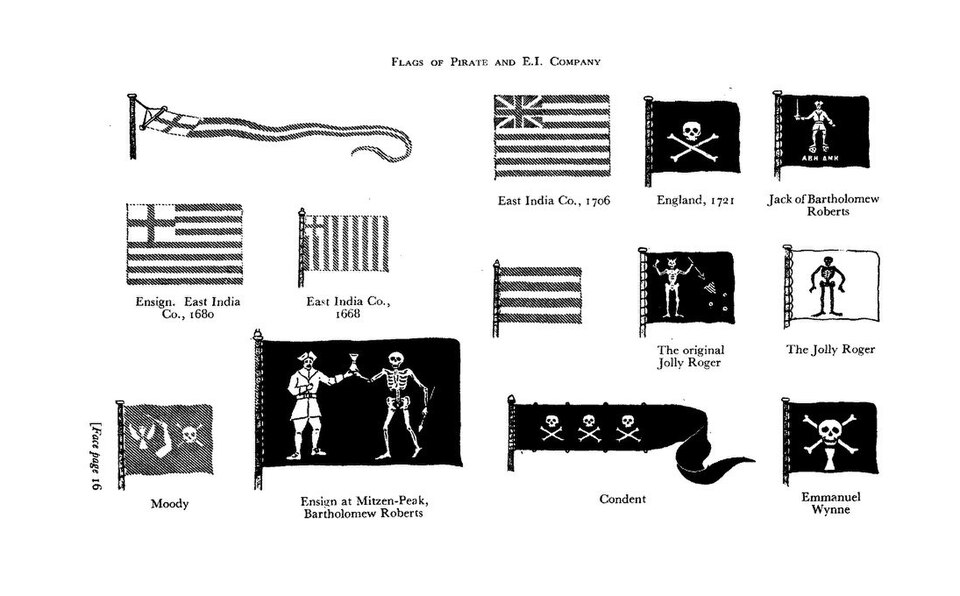
To maximize the psychological impact of their flags, Golden Age pirates drew heavily on graveyard and death imagery — a visual vocabulary that any sailor of the era would have recognized instantly from churchyards and funeral art. Emmanuel Wynne’s innovation of the skull, crossbones, and hourglass combination established the template, and subsequent captains elaborated on it according to their own tastes and intentions. The range of symbols in use across the Golden Age included:
- A pierced heart — merciless death
- A heart with drops of blood — a slow and painful death
- A dart or spear — violent death
- A skeleton — a tormented death
- An hourglass — your time is nearly gone
- A cutlass in a hand or raised fist — any and all of the above, applied without delay
What made this symbolic vocabulary so effective was that it did not need to be read so much as felt. A flag is seen at distance, in wind, often in poor light. The pirates chose symbols that communicated dread even when the details were not fully visible — a dark flag with pale shapes moving on it told the story at a glance. The specific meaning of each element was secondary to the cumulative effect of the whole.
The skull and crossbones itself outlasted the pirates who made it famous by centuries. It migrated to poison labels, electrical warnings, and military insignia. It became a fashion motif. It is today a symbol of resistance and nonconformity in contexts as varied as political movements, music subcultures, and the name of more than a few pirate-themed restaurants. The buccaneers of the Golden Age could not have predicted any of this. They were trying to rob a merchant ship. They managed, incidentally, to create one of the most enduring graphic symbols in human history.
As both an Amazon and eBay Associate I earn from qualifying purchases.
All content ©2003– The Pirate's Realm unless otherwise noted. All rights reserved.
Privacy Policy